New shared sports facility rising at Lentegeur Secondary to boost youth development
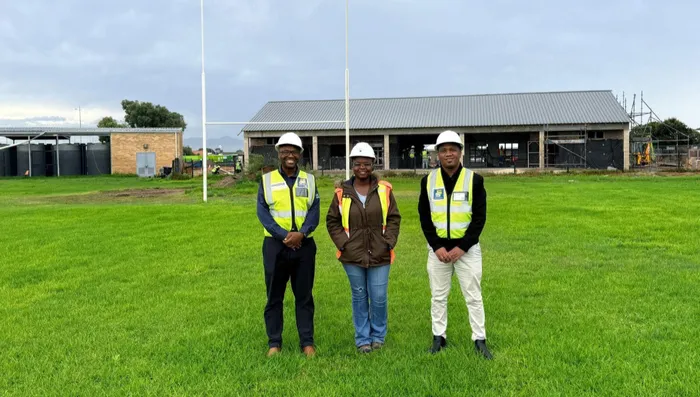
A new shared facility is under construction on the grounds of Lentegeur Secondary School as part of a broader initiative. A site visit on Monday, February 9 saw provincial MEC of Sports, Arts and Culture Ricardo MacKenzie, an inspector who did not want to be named, and ward 76 councillor Avron Plaatjies inspect progress.
Image: Supplied
A new shared facility is under construction on the grounds of Lentegeur Secondary School as part of a broader initiative to strengthen youth development, sport, and social cohesion in the Western Cape.
The project is a collaboration between the Department of Cultural Affairs and Sport (DCAS) and the Western Cape Education Department (WCED) under the Shared Facilities Initiative.
It was highlighted during the Western Cape Government’s launch of its School Sport Strategy on Tuesday, February 10, at the Lavender Hill Shared Facility.
Backed by R130 million over three years, the strategy aims to embed structured sport programmes in schools while strengthening school–community partnerships.
A site visit on Monday, February 9, saw provincial MEC of Sports, Arts and Culture Ricardo MacKenzie and ward 76 councillor Avron Plaatjies inspect progress.
The Lentegeur Shared Facility will serve Lentegeur Secondary School and Cornflower Primary School by providing upgraded sport, recreation, arts, and cultural facilities for pupils and the surrounding community, said Mr MacKenzie.
Phase 1 at Lentegeur Secondary is expected to be completed by April and Phase 2 by September, while the completion date for Cornflower Primary is still to be confirmed.
Planned facilities at Lentegeur Secondary include two rugby fields, three cricket pitches (one artificial and two natural), three cricket nets, and a clubhouse, which is pending.
Cornflower Primary will receive a multi-purpose Astroturf for hockey, football, and rugby, as well as a main hall, pending, he said.
Primary beneficiaries include pupils from the host and cluster schools participating in DCAS and WCED programmes. Secondary beneficiaries include registered community clubs, district and provincial federations, NGOs, and recognised community organisations, all for school-going pupils only, he said.
The facility will support physical education, after-school and MOD programmes, inter-school sport, competitions, recreation for children and seniors, and arts and cultural activities. High-performance pathways and talent development are included.
Facilities will not be available for private social events such as weddings, funerals, birthday parties, or functions involving alcohol, said Mr MacKenzie.
Registered clubs may apply to use the facilities for school-aged participants by submitting structured programmes and meeting governance requirements. Once completed, bookings must be submitted in writing to the Shared Facility Manager and align with DCAS and WCED objectives.
Byron De Villiers, Lentegeur CPF project coordinator, supports the development but said rugby appears to be prioritised.
“One field is available for soccer, but it has been used by a league team, leaving community clubs without access,” he said, adding that local clubs should benefit once the facility is complete.
Juven Rittles, project manager of Unchain The Plain NPO, said their motto is “Ma die kinders moet speel.”
He welcomed the project but warned the facility could be overused given the number of schools in Mitchell's Plain, stressing that management must remain focused on children’s needs.
Follow Plainsman on TikTok and Instagram @ccmonlineza